Monday, February 13, 2012

Week 17 – Colonia, Montevideo and its Carnival

This week was the originally unplanned part of our trip. After we decided to skip awfully expensive carnival in Brazil we were looking for alternative carnival experience in South America and that’s how we found out about the Montevideo carnival that is included in the UNESCO’s list of Intangible cultural heritage.

Montevideo Carnival
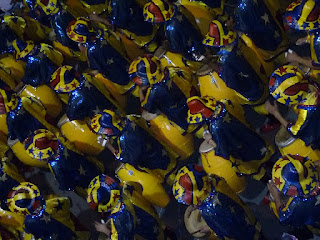
Montevideo carnival spreads throughout January and February but its biggest event is the Desfile de Llamadas (a carnival parade) that is held Thursday and Friday night at the beginning of February. This year it was 9 and 10 which suited well our travel schedule, though when we arrived a day before there were no more tickets available for the sits along the street General Flores where the parade takes place. We could just wonder the street but we paid 600 Uruguayan Pesos (=£20) to stay the night at the terrace in private house overlooking the parade. It was dear but as we found out the next day worth the price. The house was based right at the beginning of the street and the parade itself where the comparsas were at its best right before approaching the televised part of the parade. Comparsas, the groups of Negros (back people) and Lubolos (white people pretending to be black) perform at the carnival according to the specific traditional order.

First go banners and banderas at least four but typically more:
 Then the moon (or moons) and the stars (at least two) that symbolises the night but apparently has also to do with the Islamic influence brought by the African slaves:

Then the dancers at least 15 and here surprisingly unlike what I have seen from the brasilian carnival it is not all about being young and beautiful. Anybody young and older, slim and not so slim can dance, which I thought makes the event very inclusive. Still very similarly to the brasilian carnival there is a lot on display:
Then mama vieja(s) (old woman) and gramilliero(s) (old man, a village witch with the suitcases full of healing herbs):
And then the condombe drummers (at least 36) proceeded by the baton twirler and sometimes another dancing couple (this time always young and beautiful):
It was very entertaining at first but it became a bit repetitive after the tenth one as they really follow the same order. All that changes is the colours. But with the rented terrace we could see it from the top, sit down a bit and pop in to the street and shake the body to the beat of the drums with the excited locals and what is invaluable at the street event like this was the use the bathroom!  The next day, on Friday we went for the second round of carnival that was supposed to be better with more professional comparsas including the winner from last year carnival but it was not that much fun. We were standing on the a very crowded street closer to the end of the parade where the comparsas appeared to be slightly tired. Also we could not see much constantly interrupted by the vendors selling mostly the same stuff:  espuma (the foam), polystyrene snow and illuminating gadgets. So we gave up rather early and left behind very excited crows.
Murgas and Parodistas

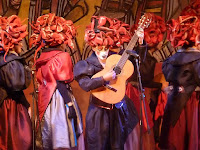
The other important part of the carnival is the tablados i.e. the neighbourhood outdoor scenes where local satirist (parodistas) and singing and acting groups (murgas) are performing. They also have a big competition for the murgas in Teatro Verano but again we could not get tickets so we bought cheap entrance to the Tablado in the Carnival museum, which was really good enough for us. We saw one group of parodistas that we could not really fully appreciate (or enjoy) considering my limited and Gavin’s no Spanish and one female only murga with some feminist theme. Even though I could not fully understand the lyrics of their songs, I thought it was a good performance, nice costumes with big fake red hair, good beat and singing and the female part of the audience seemed to have really appreciated their jokes. 

All in all I enjoyed this carnival experience and even though I do not know how it really compares to  the experience we would have had in Brazil I think Montevideo Carnival is really good inclusive popular art expressing common people’s creativity.

Montevideo

Montevideo is an average South American city full of beautiful tranquil plazas shaded by the trees. As you walk the streets you can see its glorious past from the twenties and thirties that seemed to have gone into slight decay. Its main square, Plaza Independencia, houses once the tallest building in Americas and around the corner is beautiful Teatro Solis. However, what distinguishes Montevideo is the Ramblas, promenade along the river Parana (that is so big that it looks like a sea) circumventing the city’s with sandy beaches filling up on the weekend, like the one in what grew to be our favourite Montevideo neighbourhood Positos.

Montevideo is also home to the stadium of the first Football World Cup in 1930! It is really old, all concrete stadium that also houses an interesting museum, if you interested in football of course! It displays loads of football memorabilia from early twenties to the recent days including the infamous ball used in the famous 2010 World Cup match between Uruguay and Ghana, when Suarez defended the Ghana’s goal with the hand. I watched that game and needless to say cheered for Ghana!

Montevideo seems to have one other peculiarity. There is no recycling required from the people, all is just general trash but then on the streets you see people on horse carts stopping at every garbage disposal bin and plundering through it and leaving the city at the end with the cart loaded with the valuable part of general city garbage. Could it be the more efficient way of recycling that what we know in Western Europe?

Colonia
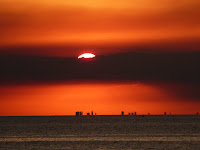
On the way from Buenos Aires to Montevideo we took a stop in Colonia. We took the ferry from BA across the river Parana that takes only 1 hour but if you think that this is only a river crossing it is rather a long time. Did I already mention that river Parana actually looks like a sea? We had enough time to spend 2 nights in Colonia to get on time to Montevideo for Desfile de Lllamadas, and contrary to the Lonely Planet recommendation to make Colonia a day trip from BA, this longer stay gives just about enough time to really enjoy this small town that is a UNESCO World Heritage Site.  Its old town is the only place in South America that mixes the Spanish and Portuguese influences: flat roof Spanish houses mingle with tile covered sloping roofs of Portuguese ones all wonderfully decorated with flowery bushes; Spanish street  with the sidewalks cross Portuguese ones that have no sideways and water drainage in the middle. It is just charming place and even though it is one of the major Uruguays tourist destination, not really overflown with tourists and typically accompanying it junk vendors. What makes the difference between a day trip and staying the night in Colonia is the wonderful sunset. As the sun sets down it exposes the high rise buildings of Buenos Aires on the horizon and it just simply beautiful. As you look at the photos, remember this is not the sunset of the sea, it is the river!  
Mate

Finally in Colonia I tried the mate. We have already seen it all over Argentina but Uruguayans seem to have taken this drink to the next level of addiction. Mate is a very bitter dink made of herbs (yerba de Paraguay) that fills up a cup made of wood, leather silver or dried small pumpkins, called mate.  Then you put a special metal straw into it and start pouring small amounts of water so that the top of the herbs on one side of the cup remains dry and then you start sipping it and then pour gain small amount of water and start sipping it, and again and again. Uruguayans seem to be doing it all day long and everywhere, in the parks, just sitting in front stairs of the house on the street. Once we saw a men coming back from bakery with a bag full of bread holding and drinking mate, so even mate drinking cannot be paused for a short walk to the bakery. Most of the spectators brought their mate to the carnival too! And it is not easy because you not only have to carry the cup and the herbs but also the thermos with the properly boiled water, actually not boiled as for mate water is only heated a bit less than boiling level. Even the electric kettles have a separate button for heating up water for mate! What I certainly remember from Uruguay other than the sights would be people holding mate cups and thermoses everywhere they go!

Next week we are going to make another diversion from our original trip plan and spend a week hopping through beaches of eastern Uruguay; one on the River Parana that anyway looks like a sea and two on the Atlantic Ocean. I shall report if the mate is also drunk on the beach.

Tuesday, February 7, 2012

Week 16 – Buenos Aires or New York

I do not even know where to begin…  Buenos Aires is great! It is a huge city but somehow really pleasant and very easy to navigate and easy to really feel like at home there. Or maybe I feel that way because instead of rushing through it in 2 days in the open top bus we rented an apartment in residential neighbourhood of Recoleta, moved around using subway, taxi or just leisurely walking through the shaded calles and avenidas. We took our time seeing the city too, only one neighbourhood a day or one museum. By the end of the week we saw all the major attractions and walked through all the central neighbourhoods but we also had enough time sleep in as we adjusted our bodies to the Argentinian life style that prohibits eating diner before 10pm! All week long I could not help but compare Buenos Aires to New York. So here is a couple of my thoughts about BA and its similarities with NYC.

Our neighbourhood, Recoleta, was so much like Upper West Side even though it did not have any brownstones. Its mostly residential buildings with doormen, of course, are so much like the one I used to live in NYC. You could look from the balcony and can see what neighbours on the other side of the street are watching on the telly; there were constant parades of dog walkers, though the Argentine ones seemed to be able to handle more dogs at a time but do not pick up the shxt. And there was Palermo, sort of like a cross between Soho and Williamsburg full of nice and posh but also funky restaurants and bars and really cool shops.

Central BA is much like Manhattan with the streets and avenues organised more or less in a grid. Even though BA does not use numbers and streets have proper names somehow it still easy to navigate once you remember the main avenues and cross streets. And if you get lost you can hail black and yellow cab everywhere or just look at them filling up the avenues. Subway though seems to be the most efficient way (and cheapest) to get through town. The network is much smaller than NYC but the platforms are the same hot in the summer. And the summer is same as NYC, hot and humid!

BA also has some wonderful shopping; I’d dare to say better than NYC! Unlike in NYC where each shopping area is full of chain stores and the small unique shops are well hidden, BA is full of independent boutiques, quality varies of course but that’s all the fun looking for the treasure. Even if you do not need to buy anything or do not like shopping, or read your books on kindle or iPad, there are two places that are a must in BA. One is the bookshop on Santa Fe converted from a theatre. It is extraordinarily beautiful and number 2 on the list of the best bookshops published by The Guaradian, after one in Maastricht and ahead of one in Porto that I saw last year and thought that bookshops cannot get anybetter. The other one is a shopping mall Galerias Pacifico in an historic building with a painted ceilings.

BA like NYC is full of culture, home of Teatro Colon that as we are told can easily rival Metropolitan Opera (it was closed for summer so we could not see anything) but also home to independent cultural centres, like the one we went to see drums performance Bomba Del Tiempo (very entertaining), where tourist easily mingle with the local ‘cool’ crowd. On one of our walks we passed by an independent cinema that seemed to have no Hollywood movies just best of the best of cine latino. It looked so much like Angelika or Sunshine in NYC. Shame, my Spanish is not good enough to see a movie without English subtitles. We had to pick an English speaking movie in a multiplex, yet we could not even see one cause all good new releases: Iron Lady, The Ides of March and J Edgar were all sold out on the Sunday afternoon. It would have been such a good way to hide in the air-conditioned cinema from the heat and see Iron Lady in Argentina, especially now that Argentines do not seem to particular fancy Brits because of the Malvinas.

Oh, and the museums! Sure Malba (Museo de Arte Latinoamericano de Buenos Aires) is not MoMA but yet we saw a really good exhibition of the works from XX century. For a moment I thought that the it was not fair to name the exhibition ‘Arte Latinoamericano’ where most of items on display were from Argentina itself but then we found some good stuff from Brasil too (I really liked Emiliano di Cavalcanti) and one painting of Ferdnado Botero and Frida Kalho too. It also housed a special exhibition of works of colour of Carlos Cruz-Diez. One of rainy afternoons we spent in Museo de Bellas Artes, again maybe it is not Googenheim or Metropolitan but still the collection was quite impressive and we got to see one of Rodin’s Kisses.

Like NYC, BA is also a heaven for foodies! It has it all, all sorts of cousins, mom and pop restaurants and high end posh places or ‘secret restaurants’ where you have to make a reservation and ring a bell to get in to the house/restaurant. We went to one, Casa de Coupage run by a sommelier who will pair up wine with your meal and offer the best bottles for tasting. By the way this is a much better way to taste Argentinian Wines than a trip to the wineries in Mendoza and it costs about the same! We tried an unknown grape, Bonarda and I was given a rare late harvest white wine with a slightly salty taste from the bodega Alfredo Roca. It was slightly pricey experience but really worth it. I cannot even imagine how much more it would have cost in NYC!  Both NYC and BA are full of pizza and pasta eateries but I will also dare to say that it is easier in BA to get good pizza and pasta in the randomly selected place than in NYC. In NYC you need to know where to go to avoid disappointment and in BA we were not disappointed once! By the way, food in Argentina is so much more than a steak, they really seem to eat lots of Italian style dishes. Here is the place to mention that we even found a Polish bar in San Telmo, called Krakow and I had a brief chat with the second generations immigrants from Poland.

There was one part of BA that is hard to compare to NYC, La Boca. Close to the port, in the past mostly inhabited by the European immigrants it is and used to be a working class neighbourhood and meatpacking district. In the last decade the NYC meatpacking district was turned around to become a fancy, cool and posh neighbourhood. La Boca, turned itself to become one of the major tourist attractions in BA, some (Gavin) would say a little bit tacky… The colourful houses are a real charm and so what that the tango dancers are posing for photos for money and that every restaurant has hosts trying to drag you in, so what that the sounds of all the life performances mingle and you cannot really hear any of them properly. I thought it was still good fun and really unique and the photos are lovely too! We avoided being dragged into any of the loud restaurants and picked quieter one with just one man with guitar signing tangos and other genres of Argentine music. He was really good, apparently he is coming this summer to sing in Europe (including Krakow) and he knew the prose of Witold Gombrowicz. That’s uncommon!

There two icons of BA that NYC does not have. One is of couse tango. I am sure you can find a place for milongas in NYC but it must be different than BA. Although I must say that it seemed a bit like the tango vibe is maintained like folklore for really passionate locals and tourists. Yet it was still fun to go for a quick 1 hour class and learn the basic step. It is difficult enough… and we got tired after about 2 hours practice! We probably broke all the rules on the dance floor so we just settled in for watching those who can tango.

Another icon is Evita. As Argentine say, you cannot be indifferent to Evita, you either love or hate her and certainly you would be interested! And so was I (Gavin less so) but I managed to get a lots of Evita in BA. We went to see a small intimate tango show in the basement based on her life story, Evita Vive (slightly overpriced but not bad). We visited museum entirely dedicated to Evita that displayed some of her famous clothing and her graveyard in Recoleta cemetery with a very interesting story of disappearance of her body. I played ‘Don’t Cry for me Argentina’ at the Casa Rosada, presidential house from where she and Peron made their famous speeches. Her huge portrait is overlooking the major avenue in BA, 9 de Julio, that is apparently the widest street in the world with 8 car lanes one way and a green space in the middle.

So this is my summery of a week in BA. I could keep going but the blog is getting a bit long and all I really wanted to say is that I really loved BA. It is a wonderful city! If you plan to visit, do not trust Lonely Planet that says you can do BA in 2 days or worse if you stay for 4 days to make a day trip to Colonia in Uruguay (as much as Colonia might be a lovely place too).  

Wednesday, February 1, 2012

Week 15 – Mendoza, Cordoba and Rosario

This week was really very uneventful and maybe sort of disappointing but mostly because I did have really high expectations from both Mendoza’s wine and Cordoba, Argentina’s second biggest city and its educational and cultural centre.

Disappointment 1: Mendoza
I was very excited about tasting all these wines in Mendoza, the heart of Argentine wine industry. We had 3 options: one to take one of many regular tours through wineries for some $40-50, a posh one that would require splashing out upwards from $160 or just go to one subregion Maipu, rent a bicycle and pop in to random wineries that accept the visits. Considering lack of regular pay checks we went for a regular tour just to see how it goes and decide on the other options later. The tour started wrong from the beginning … we spent 1 hour in the tour bus collecting people from various hotels and hostels around Mendoza. Then it got worse; we went to Navarro Corres, a winery owned by Diagio (one of the biggest if not the biggest alcohol company in the word) who after absolutely boring tour of the production process served us with their probably worst and cheapest wines. Things got slightly better with a medium-size boutique winery Vistandes, that only produces for export and own consumption at the bodega. The tour was more interesting and passionate. We got to taste their Torrontes, Argentine white grape. It was not bad really but sort of strange selection of 2008 for tasting after explaining to us that the young wine that did not age in the oak barrels is best within 2-3 years… The last winery we visited was a small winery Don Arturo where the tour was fun, tasting was ‘richer’ though the wine themselves were rather non-descript; the flagship wine of this winery were 2003 vintages that the owner aged for his daughter’s wedding in 2007, those of course we did not taste! All the wine tastings we did was before lunch; somehow it did not settle with me to drink wine that early after the meagre breakfast! The best thing of the wine tour was the lunch with a humongous picada (selection of cold cuts, cheeses, salads, fresh, grilled, marinated vegetables) that was served with the non-branded house Syrah, that turned out to be the best wine we had that day; or maybe drinking wine at not before lunch is just better altogetherJ

So my take on wine tasting in Mendoza is best to skip it. Just buy yourselves a good bottle in the shop. Most of the stores sell half bottles. It would make much better wine tasting. Mendoza itself is good to visit if you would like to do nothing but wonder the streets and hide from streets on the plazas or in the park; or alternatively if you a football fun in Argentina during the summer. Argentine league does not play so the teams play friendly summery tournaments like Copa de Mendoza. We got to see San Martin beat San Lorenzo 3:2. Sure it was not a big game like Boca v Riverplate who played there after we left (disappointing too) but it was good fun. So football not wine turned out to be the highlight of our day in Mendoza!

Disappointment 2: Cordoba

Cordoba was very hot, very very hot and there was nowhere to hide from the afternoon heat because its supposedly interesting, artsy museums did not open until 5pm or one even after 8pm! So we just wondered the streets full of cheap shops, not even a decent park or a square with benches under the trees! My highlight of Cordoba was a conversation with the owner of the small grocery shop where we were buying our nibbles for the bus to Rosario. He knew Wajda, Polanski, Kieslowski movies and what was even more surprising Zbigniew Cybulski, our polish equivalent of James Dean. It does not happen very often that the shopkeeper on the other side of the world knows so much about small polish contribution to the world’s cinema! Oh, I also liked a very cheerful hippy band that played on the streets: Manana me chanto.

Slight redemption: Rosario
I did not expect much of Rosario. I actually did not even want to go there. It was just convenient place to break the journey from Cordoba to Buenos Aires and it is at the end the birth place of Argentine flag, Che Guevara and of course Lionel Messi (for readers oblivious to football he is the best player these days!). Yet we had really good time there. It was still very hot, if not hotter than Cordoba but somehow seemed more pleasant and not as busy. Even the shops were nicer! Sitting in the café on the river Parana made a really good pass time. We did not get tickets to go on the boat to the river islands because the day boats were full but even walk through the park on the river was very pleasant! So do not get out of your way to get to Rosario but if you do enjoy it but if you want to sleep at night avoid hostel La Mansion de Nomada, decent place in good location but a hard-core party place with the barbeque on the rooftop starting at about midnight.

Next week we are going to spend in Buenos Aires. I am going to have absolutely no expectations to avoid any disappointments.

Sunday, January 22, 2012

Week 14 – Perito Moreno and Bariloche

Unlike last week when we were somewhat active this week we mostly sat on the bus. We travelled 2,641km which took us together 44 hours! So inevitably this week’s blog will be dedicated to the bus travel.

Route 40
The first and the slowest was the overnight journey from El Calafate to Perito Moreno. 621km would have taken us 14 hours on mostly unpaved (apparently famous) route 40 if the bus wouldn’t break some 2 hours before destination. It added extra 1.5h to the already turtle like ride. The bus drivers clearly struggled with the repair and needless to say there was no mobile coverage at all. Fortunately the bus was full (like always) with Israeli backpackers, one of whom managed to fix the problem with the help of a duct tape. I guess it was Israeli backpackers’ redemption after adding 1h to our journey to Punta Arenas because of illegal fruit smuggling. Still they need to do much more to redeem themselves after burning Torres. There is no much going on outside the bus window on the route 40. Really nothing, sometimes occasional guanaco would make an appearance or a livestock from the surrounding estancias. That’s it. The landscape got a little bit more varied on our next stretch from Perito Moreno to Bariloche travelling through the Lake District and Andean valleys. Luckily so because this time it was a 12 hours (800km) journey during the day. Both trips were on special bus services for tourist or as it may seem for Israeli backpackers and occasional Polish or Irish. There are almost no local passengers travelling on route 40. I guess they have no business going from El Calafate to Bariloche overland, not to mention that there is not enough of them to make any sensible demand! Even for the tourists in high season the buses are scarce, El ChaltenTravel goes every other day and Marga/Taqsa only once every four days. So, if you do not plan and buy the tickets in advance you might be really stuck!

Very sweet bus
From Bariloche we went to Mendoza on normal scheduled service and on a fully paved road. We made 1,220km in 18hours mostly overnight with an hour stopover in NeuquĂ©n. And what a bus it was! Seats and leg space more comfortable than any business class I have flown. The seats stretched to almost a flat bed. But the ‘thing’ on this bus journey were the meals. There was tea in the afternoon; the sweetest meal I have ever had with 3 types of cookies with dulce de leche, cookies with jam and crackers with dulce de leche and jam on the side in case you haven’t had enough. I did not think I needed coffee at first but then ordered one just do swallow all that sweetness, yet the coffee came sweetened too! Later there was diner service with wine (of course) preceded by dulche de leche snack and followed by digestive liquors. I skipped the breakfast but as one can expect it was also full of dulche de leche!  

Bus entertainment
The description of the bus journey would not be complete if I would not mention how entertainment provided by the service operators helps survive the long hours. It is all about really bad movies carefully selected from the big DVD library by the bus attendant. First I thought that the movies come in two categories: bad SF or worst of American comedies. SF I skipped except for one with Justin Timberlake titled ‘In Time’ but I watched ‘Hangover 2’ and ‘I pronounce you Chuck and Larry’ even though I never watch any movies with Adam Sandler. Then, however the very sweet bus surprised us with some film for children with Bill Murray and with action movie ‘The Lincoln Lawyer’. Yet for me the best way to pass time on the long bus journey was my ipod listening to the Argentinian diva Mercedes Sosa, or Andres Calamaro. Both their music goes well with the Patagonian landscape. I discovered also my new favourite tango 'Naranjo en Flor' that I replayed probably a 100 times this week.
I guess I have to explain why we ‘suffered’ all these hours, sweet food and bad movies on the bus.

We decided to visit Cueva de Las Manos, a Unesco World Heritage site with the paintings of mostly left hands (and also some guanacos, some other animals, hunting scenes, moons and some abstracts) made by indigenous inhabitants some 9000 years ago located in the Pinturas Canyon. Very impressive, almost hard to believe that it is not some modern graffiti! The closest town in the area to make a visit to the cave is Perito Moreno, very sleepy where everything or rather nothing happens on the main street San Martin. The main entertainment in town seemed to have been an afternoon dice gambling in highly overpriced hotel Belgrano, where we had to stay because of lack of alternatives.

Bariloche is the hub for seeing the wonderful scenery of the Lake District when it is not covered by the ash clouds from the erupting (since 4 May 2011) Chilean volcano Puyehue, which makes everything look rather grey.  The Icelandic volcanic ash in Europe in 2010 was nothing compared to this! The ash clouds have cleared up slightly when we were hanging out in town resting after the bus journey but then it went back to grey when we cycled Circuito Chico up in the lakes. The sitting and nibbling on the bus must have taken its toll on our fitness; we have really struggled to cycle undulating 32 km. It took us a disgraceful 7 hours with the long lunch break on the lake, ice cream in the Swiss village and a slight detour among barking dogs! But it was a good and rewarding cycle and in our time and budget probably the best way to get a glimpse of the Lake District.

To Mendoza we travelled of course for wineries and Argentinian Malbec tasting, unfortunately not for summiting Aconcagua like my fellow polish explorers; no fitness, time or money for this. But wine is coming next week. We just booked our first wine tour for Monday!

Tuesday, January 17, 2012

Week 13 – Torres Del Paine/Puerto Natales (Chile) and Glacieros/El Calafate (Argentina)

This week has been all about hiking and so will be this blog entry but because we stayed in the very interesting accommodation in both Puerto Natales and El Calafate I will first say a few worlds about them in case somebody would like to use it as recommendation for future trips.

Puerto Natales is a little sleepy town on the shores of the Sound of Last Hope (in Spanish it sounds even better Seno Ăšltima Esperanza) that serves as base for people heading to Torres Del Paine, famous Chilean National Park and as a transport hub between Punta Arenas and El Calafate. Therefore it has lots of tourist facilities; it seemed like every other house in the centre was a hotel or hostel, restaurant or tourist agency among shops with the travel gear. We read somewhere that no booking was necessary in Puerto Natales because the people with free rooms are meeting tourists at the bus terminal. We thought we try our luck like we did in the Western Balkans. To our disappointment there was only one older lady at the bus stop so we did not have much choice or bargaining power.  She turned out to be a mad woman owner and the heart of the hostel El Mirador, cheap and dated but clean establishment outside of the town centre close, where on the first night we were the only guests. It took the mad woman no more than 5 minutes to arrange for our bus to Torres del Paine, outward bus to El Calafate and recommend the best place to eat in town. Later as we were walking through town we often saw her cruising in her SUV way above the town’s speed limit. Her madness proved to be very handy for us because she seemed to have been always around to give us a lift to or from town. I thought that the hostel should be maybe renamed to Mad Woman but then we saw the binoculars at the window. She has probably been using them to spot the buses arriving to town to come down to town and get more guests hence the name El Mirador is probably appropriate.

El Calafate is a modern very commercialised town on lake Argentina with very good tourist infrastructure around its bustling main street San Martin that serves as base for day trips to the Parque National del Los Glacieros. This time we booked our accommodation because we heard that it gets very full in high season. We found Hospedaje Lautaro on hostelworld.com (I guess it did not make it yet to latest edition of Lonely Planet but I am sure it soon will) and chose it both for price and ratings. It turned out to be a lovely small hostel on a quiet street, yet very close to the centre, run by Belen, former tourist guide who was the friendliest source of all information and Dario, a former chef who cooks a few dishes in the evenings just for the guests from the best of what Patagonia has to offer. We had very tasty homemade fettuccini with wild mushroom sauce, so good that we had again the second night and wonderful pastel de papa, a dish very similar to shepard’s pie. It was a very nice change from not very creative Chilean fast food dishes and steaks and pizzas that dominate menus in the restaurants.

So now back to hiking, in chronological order:
Torres Del Paine – When we arrived in Puerto Natales we already knew about the fire that was burning significant portion of the park (allegedly started by one of many Israeli campers in the region). We knew hiking routes were limited but in any event we only had an appetite for not more than 2 or 3 days trek in the wilderness. Luckily, the trek to the view point of the Torres themselves was open and we saw them on the first day. On the second day after overnighting in the shelter El Chileno, we did Los Cuernos leg of the trek, scenic and relaxing but long walk along the lakes. We ended our last day in the park with a couple of hours wait for the bus back to Puerto Natales. Waiting would have been really boring if it wouldn’t be for a parade of beautiful horses walking past to another gazing field finished with a spectacular sight of the gaucho herding them.


Reserva Nimez – After we arrived in El Calafate we had a spare day of wondering around and doing nothing before we could go on a day trip to Perito Moreno. We spent most of it on a very slow 3 hours walk in the bird’s reserve along the lake. It was a real treat for a newly discovered and emerging birdwatcher in me. I am not very educated, yet, so I cannot really name the species but we saw flamingos, lots of different ducks, geese and some small flying birds (apologies to all the real birdwatchers that might ever read this blog). Thanks to a stray dog that decided to walk with us (until he started to follow some other tourist) we got an up close encounter with some sort of birds of prey (again apologies to real birdwatchers) that followed him until they decided he was too big for them to attack.

Perito Moreno – Perito Moreno glacier is part of the Parque National De Los Glaciares and part of the third largest ice field (after Antarctic and Greenland). We did a day trip that included 1.5 hours walking in crampons on ice. It actually was much easier than I thought. Or maybe it was easy because we were told exactly where to step to avoid any ‘wholes’ or other dangers. It was a very good day and I do not think I have to say how spectacular it was. Just see the photos. We could also visit the glacier just by walking on the viewing balconies and taking a regular boat trip and skip the trek which was much cheaper option but I thought the mini trek was worth the price for somebody who may never have an opportunity to step on a glacier.

Lago Roca – We had one extra day to spare in El Calafate because we could not get our onward tickets. We read about Lago Roca, the southern corner of the Parque National de Los Glaciares, in Frommers that we randomly picked in our hostel. Frommer’s said that Lago Roca was an undiscovered secret of the region offering spectacular views of both Perito Moreno and, on a clear day, Torres Del Paine. So it was an easy choice for our spare day. What Frommers said was absolutely true. The views were spectacular and it was rather empty over there, no words necessary if you look at the pictures. What Frommer’s (or Lonely Planet or the locals) did not say was how strenuous the hike to get those lovely views is. It also did not warn us about jinxing German!  When we started hiking, the 1000m ascent, described on the local map as 4h medium trek we were alone on the path. We were doing really well and well ahead of the scheduled time until some 200 meters before the top when German caught up with us with his super hiking boots and pols. After a very friendly chat he set off to the peak while we took a water break and watched him struggling up the last 100 meters. Then we followed just to discover that some 50-60 meters before the top that I was paralyzed by fear on a very steep, dusty path. I couldn’t do a step forward or backwards. I barely kept my balance on what then seem to me a vertical slope with the sliding gravel surface. And so we turned back sliding our asses down on the gravel… Very unfulfilling to miss the peak by some 50 meters but I guess one has to know the limits. At that time we did not know that it was the German jinx, until he caught up with us again on our way down after our picnic lunch. We started to walk down together chatting our way but three people walking together create too much dust so he decided to go ahead alone. Then I realized I left my camera on our lunch spot. It was there but recovering it cost us climbing up another 150m and worse coming it down again! Anyway, absent German jinx, it was a really good day trip. Highly recommended if you every make it to El Calafate, I just maybe have to tell the national park guards to design the last part of the path in some smoother zigzagging manner rather than straight up!

That’s it for hiking stories. The treks we done this week were just about enough to get us back in shape. We are now heading north and not planning any more substantial trekking, unless absolutely necessary!

Ps: As I discovered in the bus back from Lago Roca to El Calafate, the jinxing German studied BWL in Tuebingen, about the same time where I was there as an exchange student. He now lives in Augsburg and follows the opinions of prof. Starbatty who now is a well-known Eurosceptic.

Wednesday, January 11, 2012

Week 12 – Ushuaia (Argentina) and Punta Arenas (Chile)

This blog entry will be about what happens at the end of the world (or rather its more southern corner) and it will be very short because other than being stunningly beautiful not much happens here at all, especially in sleepy towns with lots of tourist infrastructure but not to many tourists at all.
How long are the days at the end of the world?
When we arrived in Ushuaia on Tuesday (3/1/2012) after a long journey via Madrid and Buenos Aires we were exhausted and went to bed rather early and woke up late so I had no idea that the sun sets close to 11pm. I discovered it the next day when we walked to the hostel from the Irish pub ‘Dublin’ in the daylight! The following day I was wearing sunglasses at about 9pm. Incredible! On Saturday we walked at about 4:30am to the bus station to catch the 5am bus to Punta Arenas in the daylight looking at the still slightly pink clouds over the Beagle Channel. I realise that this is known fact that the days are longer at the southern-most end of the world but yet it felt sort of out of this world. I guess the long days are also a reason why the locals do not seem to eat dinner before 8pm, with restaurants still filling up long past 9pm. We just have to adjust our bodies to the new schedule.

What did we do on the long days at the end of world?
I never thought of myself as the wildlife aficionado or worst a birdwatcher. Yet, I wholeheartedly enjoyed a visit to the penguin island and a costal walk in Tierra del Fuego national park. Unlike more tourists in Ushuaia who take a long cruise through the Beagle Channel (named after the ship that Darwin sailed on) and see the penguins only from the boat and considering my aptitude for the seasickness we decided to take a different option with Piratour. It involved 1.5 hour bus ride to Estancia Harberton and only 15 minutes on the small boat to the Isla Martillo, with the colony of some 14 thousand Magellanic and a small colony of Papua penguins. This is the only tour in town with permission to walk on the island among the penguins. Our tour guide, Marcia, was really wonderful. The penguin families were now bringing up their little ones that were about 40 days old. It was very exciting to walk among those little families of 4 (Magellanic penguins have always 2 kids) and even more so among the 1 year old youngsters, who unable to nest, are just hanging out on the beach. I had to, however, contain the excitement not stress the penguins!
The next day we went to the Tierra del Fuego National Park, mindful of being out shape after long hours spent at the table at home at Christmas and New Year, we picked costal hike on the banks of Beagle Channel that did not ascent too much. Strangely enough, as we were walking the sun always shone when we were crossing the beach and the rain came when we were in the shelter of the Fuegian forest. Other than the lovely landscapes we saw a fox, rabbits, and black-necked swans and some other ducks. We ended our walk at the end of national route 3. You could say that this was the end of any roads in South American continent. And like anything at the end of the world, there was not much happening there, just the end of the road with a parking spot.

When we went to Punta Arenas, a sleepy town in Chilean Terra del Fuego (I think it is southern-most city in Chile) we decided to rent bicycles for two reasons; (1) to get back in shape a bit, (2) considering our post-Ushuaia budget shrinking we could not really afford another trip to the penguins, even though here it was the major attraction in town. We decided to cycle up to the forest above the town but failed to find the way. We could not really ask the neighbourhood dogs which seemed to be the only creatures we saw on the way. Cycling steep uphill on the gravelled street only confirmed how out of shape we were! So we returned and ended up cycling through town and some 15km south of town in the sun and wind along the Straits of Magellan. We had pick lunch on some deserted beach nested between fishing villages or rather cemeteries of really old ships.

What not to do when crossing the border between Argentina and Chile?
We took a regular bus from Ushuaia that was supposed to get us to Punta Arenas at about 4.30 pm after 11.5 hours. As if the scheduled time was not long enough we arrived some 3 hours later. Luckily (as noted above), the days are long here so we still had time to check into the hostel and have a nice dinner at local treasure restaurant La Marmita. Some of the delay was attributed to the busy border crossing with several buses arriving there at the same time at least 1 hour delay was because of 3 fellow travellers who decided to ‘smuggle’ 1 apple, 1 orange and 3 tangerines across the border. The border guards turned out to be very strict about and ended up writing them up with warning and detailed stamped reports on the smuggling. I guess there must be good reasons to for protecting own habitats, so for future reference please do not try to break the rules for your own and fellow passengers comfort!

After the border the ride was smooth. We had to cross the Straights of Magellan on the short ferry ride at Punta Delgada. Just to reaffirm that nothing happens at the end of the world, there was nothing to see from the ferry, just long stretches of water and a lighthouse closer to the shore. Not much happened on land either; just big fields with sheep, cows, occasional guanaco and a newly discovered birdwatcher in me spotted one nandu (sort of an ostrich known as rhia in English).
This is it for my account of nothing happening at the end of the world. Next week we continue to travel north to the world famous national parks Torres Del Paine in Chile and Los Glaciares back in Argentina. Another border crossing is awaiting us, hopefully smother this time.

Week 10 and 11 Vietnam – Cycle Ho Chi Minh to Hue, Night train Hue to Hanoi, Boat on Ha Long Bay

Another overdue blog entry but I do have a really valid excuse. It was very hard to find time to blog after cycling all day followed by hot shower to keep the muscles in relatively little pain followed further by lovely dinners where we explored the best of the best of local cooking and tasted local beers or surprisingly nice Vietnamese wine from Dalat. So here I am typing this blog already home in Poland in the middle of Christmas preparation and finalising it while waiting in Madrid for our flight to Buenos Aires and publishing already in Chile.

Cycling
I am not sure where to start, so much as happened in these two weeks! We started easy with a 20km ride from Ho Chi Mingh to the Vietkong tunnels where the purpose of the ride was to get a feel for the bikes.  And since then every day was more difficult but yet more rewarding because despite more and more sore muscles I could feel the ability and fitness rising with every km on the bike. To the point that when on the 10th day of the trip (from Hoi An to Hue) when we climbed up the Hai Van pass at 500m I (couch potato) thought it was not that difficult. But do not get me wrong a continued clime 10% for 10 km was hard! But as always with this kind of effort the views on the way: jungle forest, coffe and dragon fruit plantations, rice fields, the fishing villages with its blue boats and beaches (including the famous China beach) plus the satisfaction you feel at the end of each day where very rewarding.
Another reward was the Vietnamese kids in the villages along the way. They did not let us pass without screaming hello or trying high five. Occasionally they would try to race us a short distance on their simple, no-gear bicycles and sometimes they would win! Or as on one break they would just hang around with us being so excited about every gesture of interest.

Hardest Day
While Hai Van pass was possibly the biggest climb in the trip for me two other days were much harder to cycle. The hardest by far was 80km day from Nha Trang to Quy Nhon where we cycled all afternoon in the rain and into a head wind. The head wind was so strong that at some point where we turned around the mountain ridge I could not balance myself on the bike and had to walk a few meters until I was able to shelter behind the next turn. Even at some downhill slopes I had to pedal because otherwise the bike would have come to a standstill!

Easiest day (supposedly)
The 100km day from Dalat to Nha Trang started with a 50km downhill ride. Supposed to be nice and easy way down yet it was another hard day for me but not necessarily for my fellow cyclists who seem to have enjoyed it wholeheartedly. The top of the mountain was covered in the incredibly dense jungle mist with the visibility of not more than 5 meters. It was for me as nerve wrecking as a rollercoaster. At the bottom of the mountain the visibility and the weather improved somewhat but still the pace of downhill was a bit much for me so I rode slowly on the breaks (probably a cycling crime) and arrived last at the lunch break some 20 minutes after the rest of the group! Later I found out that the trip mechanic who had to stay behind me all the way was previously a racing cyclist. I could only imagine how painful it was for him to go so slow downhill yet he patiently followed my turtle pace.

Spookiest day
On a way to Hue we cycled flat. It was nice and easy 100k ride among… graveyards! Apparently people around Hue (former capital of Vietnam) are very superstitious and believe in worshiping the ancestors and build them incredibly ornamental and often very large (larger than their own home) expensive graves. They stretch along the road and sometimes in the middle of rice fields. It was quite spooky experience to see nothing else for some 20 km but graves… Not to mention trying to find a spot to pee in the emergencyJ that would not offend the ancestors! 
Non-cycling days
In the trip we had two days break from the bicycle designed to see the best of the Vietnamese costal town, or maybe to get some time lying on the beach which we could not enjoy cause of the rainy weather) or maybe just to give the butt a rest from the saddle, which my backside was really grateful for. We stopped for a day in Nha Trang and Hoi Anh. Nha Trang is not a very exciting place with a temple with a giant Buddha and a site with well-maintained Cham Towers but it has mud baths. We awarded ourselves with an afternoon soaking in the mud and mineral tubs watching the rain dropping on the jungle covered mountains and really good massage.


The other day break was in Hoi An, very cheerful somewhat touristy historical town set on the river banks. Sightseeing was interesting, the Japanese-Chinese friendship bridge, temple and ancient houses and the wonderful market. We also made a half day trip to My Son, a not very well maintained and damaged in the war site of Cham constructions from about the same time as Ankor Wat (though those who have been at Ankor Wat said it was not as good). Anyway, the day in Hoi An was all about shopping!  Hoi An is the shopping capital of Vietnam. It has tons of trinket but also lots of hidden treasures and I ended up spending some money from ‘the other budget’.
 
The trip finished with a night train ride from Hue to Hanoi where we transferred for a one day/one night cruise on the Ha Long Bay, one of the new 7 natural wonders of the word that defeated Masurian Lakes in the vote. It would have been probably much nicer if the weather were more considerate of our short stay in the bay. It rained a little bit but it was overcast, grey and a bit cold. Yet, I dared to swim for a few minutes in the bay given that it was my last to swim in the South China sea.

Ho Chi Minh or Hanoi

On our last day in Vietnam we went to a Pho restaurant for our last pho. We were sat at the two empty seats and picked our beef style for the pho when we were joined by the English man with his Vietnamese fiancĂ© whom we already met for lunch the day before in the local Bun restaurant… Rather uncommon encounter in the city of 10mln people. If you meet strangers two days in a row it is time to chat. We found out that they are getting married in January and their biggest decision was where to settle in Ho Chi Minh or Hanoi. I so could relate to their hardship in making this choice. Both cities are vibrant, full of life and motorcycle traffic, but Ho Chi Minh City had slightly more European feel to it with is wide avenues and western style shopping malls, large and expensive hotels. Hanoi appeared to have kept its Asian fare busy with small family run businesses. So it is a hard choice to pick either to live in. Luckily as a tourist you can visit both and there is no need to decide which one is the favourite! I liked them bothJ

Pho, Bun or Cau Lau
Ho Chi Minh or Hanoi is a tough call; it seemed to me however that everybody was either a Pho or Bun person. Pho is a clear broth with white noodles served either with slices of different styles of beef of your choice or chicken which you then spice yourself with a bit of chilli and lots of fresh herbs, bean sprouts and lime. Bun is slightly more complicated dish and involves more effort from the ‘eater’. All the ingredients are served separate: cold noodles, fried pieces of pork in the slightly fatty broth, garlic crushed with chillies and a plate of fresh herbs (of course) that you put in the bowl as you like it.
For those that cannot decide the favourite between the pho and bun there is also a dish ‘in the middle’: Cau Lau served only in Hoi An. It is made of thick noodles (slightly similar to the german spatzle for my germanofil friends) served with sautĂ© pork and its jus, and as always with some herbs and lettuce. Unlike pho or bun it is served ready to eat so there is no work before diving into the bow. I do not think I liked it more than pho or bun but yet I had 3 times in a row while we were in Hoi An considering that it is confined to such a small area that I may not visit again (or at least not for a long time).

Generally the food in Vietnam was wonderful. We enjoyed every single meal whether in posh or street restaurant. The only exception was the food on the train from Hue to Hanoi but that often is the case when it comes to train food in any country.

At the end of the trip when we said our good byes to the fellow cycling tourist and our wonderful trip crew we had to fill out the trip evaluation. One of the questions in the form asked what was the highlight of the trip. It was very hard to answer because every day was different and equally wonderful! And such was my response. Today I can also easily conclude that Vietnam is my favourite travel destination, beautiful and varied landscape, different and interesting culture, lovely people, exciting shopping and wonderful and really varied food… and contrary to my expectation it was much more to it than the world famous fish sauce!


To all my friends: Start planning your trip to Vietnam, it does not have to be cycling, however you travel I am sure you’ll have wonderful time!